
Agorapulse has seven alternatives worth evaluating in 2026: Buffer, Metricool, Sendible, SocialBee, Hootsuite, Planable, and PostMonk. I scored every one on the same seven-category rubric that gave Agorapulse 3.5/5, then matched each to the Agorapulse frustration it actually solves.
Three triggers drive almost every departure. Per-user pricing compounds with headcount. Scheduled posts fail without a proactive alert. Multi-profile analytics sit behind the $149 per user Advanced tier.
Below: the ranked quick list, then an honest read on why teams leave Agorapulse and where it still wins. Then the switching criteria, a comparison table with Agorapulse as the reference row, and migration detail per option.
Best Agorapulse Alternatives at a Glance
These are the seven alternatives, ordered by switching-fit tier first, then by overall score within each tier.
-
Buffer
-
Metricool
-
Sendible
-
SocialBee
-
Hootsuite
-
Planable
-
PostMonk
Disclosure: PostMonk publishes this guide and competes with Agorapulse and every tool listed here. PostMonk appears at the position its score earns, seventh, not first.
How we score: Every product carries the overall score from our published review methodology. It weights scheduling 25%, channels 20%, content creation 15%, analytics 15%, ease of use 10%, pricing 10%, and support 5%. This list is ordered by switching-fit tier, then by that score. Read the full method at how we review social media management tools.
Why People Switch from Agorapulse
Teams leave Agorapulse primarily because per-user pricing compounds with headcount and because scheduled posts fail without a proactive alert. Agorapulse excels at unified inbox management and Google Analytics ROI attribution, which keeps it the right tool for agencies that live in both.
Agorapulse’s unified social inbox is the strongest I have worked in at this price tier. It pulls DMs, comments, ad comments, and mentions from all 11 connected networks into one moderated queue. An Inbox Assistant auto-labels and routes what arrives, and Capterra reviewers rated team collaboration 97% positive across 86 reviews.
Its Social Media ROI feature ties organic posts to Google Analytics traffic, leads, and revenue. Almost nothing else in this price band attempts that attribution. Agorapulse rates 4.5/5 from 973 G2 reviews and 4.6/5 from 713 Capterra reviews. It also holds SOC 2 Type II and ISO 27001:2022, which no alternative in this pool matches.
The switching pressure comes from three specific friction points.
-
Per-user pricing compounds with every seat. Base plans include one user and 10 social profiles. A 3-person Standard team pays $237 per month, or $2,844 a year, before add-ons. A 5-person Professional team reaches $595 per month, or $7,140 a year. (Source:
-
Scheduled posts fail without a proactive alert. An in-app notice appears after a failure, but only once someone logs in and looks. The pattern runs across G2, Capterra, and Gartner reviews from 2021 through 2026: “Posts will not go out sometimes for no apparent reason” (G2, Government Administration). A Gartner Peer Insights reviewer wrote that “posts fail to publish more than I think they should for what I pay.” Capterra reviewers cited technical glitches in 69% of negative reviews, 68 mentions in total.
-
Multi-profile analytics sit behind the Advanced tier. Cross-profile custom reports and competitor benchmarking start at Advanced, $149 per user per month on annual billing. Standard ($79) and Professional ($119) users cannot run them. Advanced Listening and Advocacy are separate add-ons whose prices Agorapulse does not publish. One G2 reviewer put it plainly: “Moving all the analytics behind an additional fee is lame… you cannot make even simple comparisons on a single account.”
Honest carve-out: Agorapulse stays the right tool for agencies and B2B teams whose day runs through the inbox and whose reporting has to prove revenue. If you moderate ad comments, assign DMs across a team, or send clients a Google Analytics ROI number every month, no alternative below replaces that. The tools here outperform Agorapulse specifically on cost structure, analytics access, approval UX, or publishing workflow, and on nothing else.
For the full assessment of where Agorapulse earns its price and where it does not, read the Agorapulse review.
How to Choose an Agorapulse Alternative
Six criteria decide this migration, and they map directly to the friction points above.
Pricing model: per seat, per channel, per workspace, or one time
The pricing model matters more than the sticker price when you are leaving a per-seat tool. Per-seat billing scales with headcount, so a growing team pays more for the same output. Per-channel billing scales with the number of accounts you publish to. Per-workspace billing scales with client count and ignores headcount entirely. One-time pricing removes the recurring line item and shifts the risk to product longevity instead.
Work out which axis your business actually grows along. A 3-person team on 10 profiles pays very differently under each model, and the cheapest headline price is rarely the cheapest total.
Social inbox dependency: how many hours live in the queue
Count the hours your team spends in Agorapulse’s inbox before you compare anything else. Unified inbox depth is the single capability most alternatives do not replicate, and no pricing saving compensates for losing it.
A tool that consolidates DMs, organic comments, ad comments, and mentions across every network is a different product. A tool that shows comments profile by profile is not a replacement for it. Audit whether you use assignment, moderation rules, and ad comment handling, or whether you reply to a handful of comments a week.
Analytics access: included in the plan or gated behind a tier
Check where cross-profile reporting sits in each tier, not whether the tool has analytics. Nearly every platform in this category lists analytics as a feature; the difference is which plan releases cross-account comparison, competitor benchmarking, and white-label PDF export.
Ask three questions of any pricing page. Does the base paid plan report across all connected accounts? Is white-label or branded export included or a paid add-on? Is there a separate analytics module with its own monthly fee per workspace?
Approval depth: internal review or client-facing portal
Approval workflows split into two very different things. Internal approval means a teammate reviews a draft inside the tool. Client-facing approval means an external stakeholder reviews and signs off without a paid seat or an account.
If clients approve your content, the second kind is the requirement, and the gap between the two is where most agency migrations go wrong. Check whether guest reviewers cost money, whether approval is single-step or multi-level, and whether rejection comments thread on the post itself.
Migration cost: what actually transfers out of Agorapulse
No tool in this category ships a direct Agorapulse importer, so plan for a clean break rather than a migration. Agorapulse exports scheduled content, analytics, and reports in CSV, PDF, and PowerPoint from its Reports section, and that export is your entire starting position.
Historical analytics, inbox history, saved replies, and listening data do not transfer anywhere. Every alternative requires fresh OAuth authorization per network and manual re-queuing of scheduled posts. Budget the calendar rebuild in hours, not minutes.
Compliance requirements: SOC 2 Type II and ISO 27001
Confirm your compliance floor before shortlisting, because it eliminates most of the field immediately. Agorapulse holds both SOC 2 Type II and ISO 27001:2022, and no alternative covered here holds both.
Enterprise clients, regulated industries, and public-sector accounts frequently require documented certification in procurement. If yours does, the honest answer is that switching is not available to you on this shortlist.
With those six criteria set, here is how the seven alternatives compare against Agorapulse directly.
Agorapulse Alternatives Compared
This table uses the canonical order applied throughout the page: Tier 1, then Tier 2, then the brand, with Agorapulse as the reference row.
| Tool | Overall | Pricing model | Entry price | Free plan | Social inbox | Analytics | MCP / AI |
|---|---|---|---|---|---|---|---|
| Buffer | 3.5/5 | Per channel | $5/channel/mo (annual) | Yes (3 channels) | Comments only | Basic (2.5/5) | MCP yes; BYOK no |
| Metricool | 3.5/5 | Per brand | ~$20/mo (1 brand) | Yes (1 brand, 20 posts) | Yes (DMs, comments, mentions) | Included (5.0/5) | No MCP; BYOK no |
| Sendible | 3.3/5 | Per workspace | ~$29/mo (annual) | No (14-day trial) | Partial (no X/Twitter) | Included (3.5/5) | No MCP; BYOK no |
| SocialBee | 3.3/5 | Per plan | $24.20/mo (annual) | No (14-day trial) | Partial (6 of 10 networks) | Basic (3.0/5) | No MCP; BYOK no |
| Hootsuite | 3.6/5 | Per plan (seats extra) | $99/mo (Standard) | No (14-day trial) | Yes | Included (4.0/5) | No native MCP; BYOK no |
| Planable | 3.6/5 | Per workspace | $33/workspace/mo | Yes (first 50 posts) | Add-on ($7.50/workspace) | Add-on, $12/workspace (2.5/5) | Draft-only MCP; BYOK no |
| PostMonk | 3.1/5 | One-time lifetime | $29 (Starter) | No (7-day trial) | No | Basic (2.5/5) | MCP yes (Pro/Agency); BYOK yes (all plans) |
| Agorapulse (current tool) | 3.5/5 | Per user | $79/user/mo (Standard, annual) | Yes (1 user, 3 profiles) | Yes (full, 4.5/5) | Gated (3.5/5) | MCP yes (assistants only); BYOK no |
Prices and features verified as of July 2026. Agorapulse data is sourced from its live pricing page, linked above. Metricool prices are listed in euros on its own site, so the dollar figures here are approximate. Visit each product’s pricing page for current rates.
Statusbrew and Zoho Social appear often in the “agorapulse alternatives” search results. Both are excluded from the scored sections here, because neither has been reviewed under this methodology yet. Both are worth evaluating if you need enterprise inbox automation (Statusbrew) or native Zoho CRM sync (Zoho Social).
What Reddit recommends
Reddit ranks third for “agorapulse alternatives,” and “agorapulse alternatives reddit” is a related search on that query. The r/socialmedia thread on Agorapulse alternatives names Sprinklr Social, Hootsuite, Sprout Social, Buffer, and Sendible.
One commenter calls Hootsuite, Sprout Social, and Buffer “the usual suspects” for large profile counts, then warns they get pricey fast. That warning is the reason two of those Reddit picks are missing from the scored list above.
Sprout Social starts at $199 per user per month and Sprinklr is enterprise-quoted. Both raise the bill a departing Agorapulse user is trying to cut, so neither earns a section here.
1. Buffer: Best Per-Channel Pricing Alternative (3.5/5)
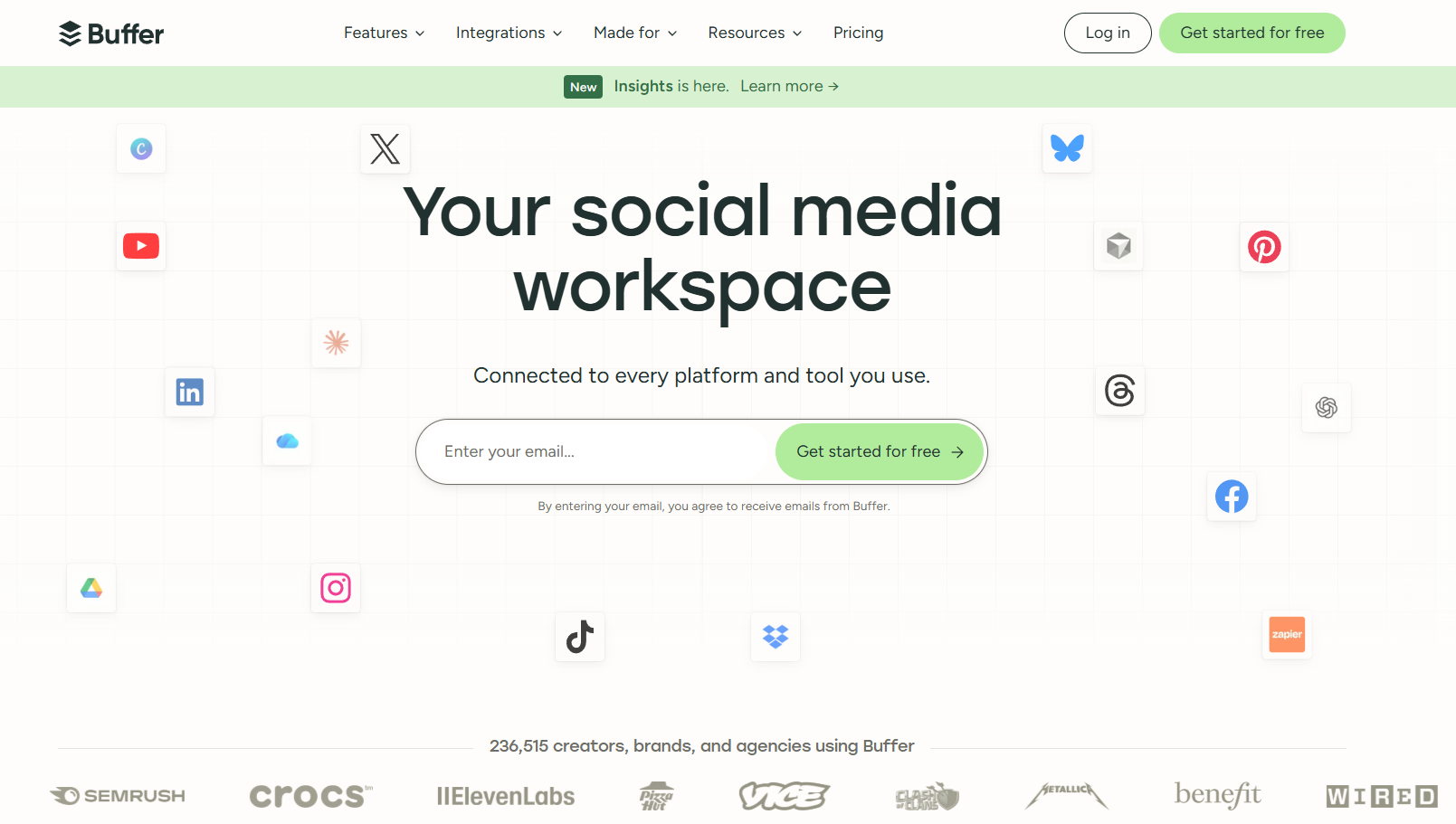
Buffer scores 3.5/5 overall, matching Agorapulse, and it is the cleanest structural answer to per-seat billing. Its Team plan charges $10 per channel per month and includes unlimited team members, so headcount stops driving the invoice. A 3-person team on 10 channels pays $100 per month against $237 for three Agorapulse Standard seats, a difference of $1,644 a year.
The trade is blunt. Buffer has no unified social inbox, no Google Analytics ROI attribution, and scores 2.5/5 on analytics against Agorapulse’s 3.5/5. It solves the pricing trigger and makes the analytics trigger worse.
Best for: Teams leaving Agorapulse over per-user pricing whose daily workflow does not run through the social inbox or ROI attribution.
Key Features
Four capabilities define Buffer for someone arriving from Agorapulse.
-
Per-channel billing with unlimited seats. Adding a collaborator on Team costs nothing; adding a channel costs $10 per month.
-
Fastest onboarding in the category. Buffer scores 4.5/5 on ease of use, the highest of any tool on this page, against Agorapulse’s 4.0/5.
-
Native MCP server. Buffer publishes an MCP surface covering posts, ideas, queue, and channel management. Analytics and community actions are listed as coming next on
-
Fully published pricing. Every tier and limit is on the pricing page, with no unlisted add-ons and no demo requirement.
Pros
These are the advantages that hold up against Agorapulse specifically.
-
Channel-based pricing scales with content volume rather than headcount, which is the exact escalation Agorapulse users are escaping.
-
The free plan is genuinely usable for evaluation: 3 channels, 10 queued posts per channel, and 100 stored ideas, with no time limit.
-
Ideas board, kanban view, and AI rewriting cover the drafting workflow without a separate tool.
-
Support is rated 4.0/5 on our rubric and is consistently described as fast and human across
Cons
Three limitations matter enough to change the decision.
-
No unified social inbox. Buffer has basic comment management, but no DM consolidation, no ad comment moderation, no Inbox Assistant, and no CRM contact history.
-
Analytics score 2.5/5, below Agorapulse. There is no social listening, no competitor benchmarking, and only 30 days of history on the free tier. Switching here for analytics reasons trades one gap for a different one.
-
Same silent post failure pattern. Buffer’s publishing failures are documented on G2 and Capterra just as Agorapulse’s are. Do not switch expecting a reliability improvement.
-
No BYOK AI. The AI assistant runs on Buffer’s managed OpenAI key, with no option to connect your own.
Pricing
Buffer publishes three tiers, and the per-channel structure is what changes the math against Agorapulse.
| Plan | Monthly (annual billing) | Users | Channels / Profiles |
|---|---|---|---|
| Buffer Free | $0 | 1 | 3 channels |
| Buffer Essentials | $5/channel | 1 | Unlimited |
| Buffer Team | $10/channel | Unlimited | Unlimited |
| Agorapulse Standard | $79/user | 1 | 10 profiles |
| Agorapulse Professional | $119/user | 1 | 10 profiles |
For a 3-person team on 10 channels, Buffer Team costs $100 per month against $237 for Agorapulse Standard. Current rates are on Buffer’s pricing page.
What Users Say
Two reviews capture the split between Buffer’s interface and its publishing record.
-
“Buffer turned daily social media chaos into a clean weekly workflow.” (Raj P., G2)
-
“Every so often, some scheduled posts fail to publish.” (Richard M., G2)
Migrating from Agorapulse to Buffer
Migration is manual, and Buffer’s Help Center carries no Agorapulse importer.
-
Export your content calendar from Agorapulse’s Reports and Export section before you cancel.
-
Export analytics as PDF or CSV. Historical performance data does not transfer.
-
Create the Buffer account and connect each channel. Every network needs fresh OAuth authorization.
-
Re-queue scheduled posts by hand, or rebuild them from your CSV export.
-
Rebuild approvals on Buffer Team. Multi-step client approval portals are not available at any tier.
-
Connect Buffer’s MCP server if AI agents are part of your publishing workflow.
Read the Buffer review for the full scorecard, or see Buffer alternatives if Buffer is also not the fit.
2. Metricool: Best Alternative for Included Analytics (3.5/5)
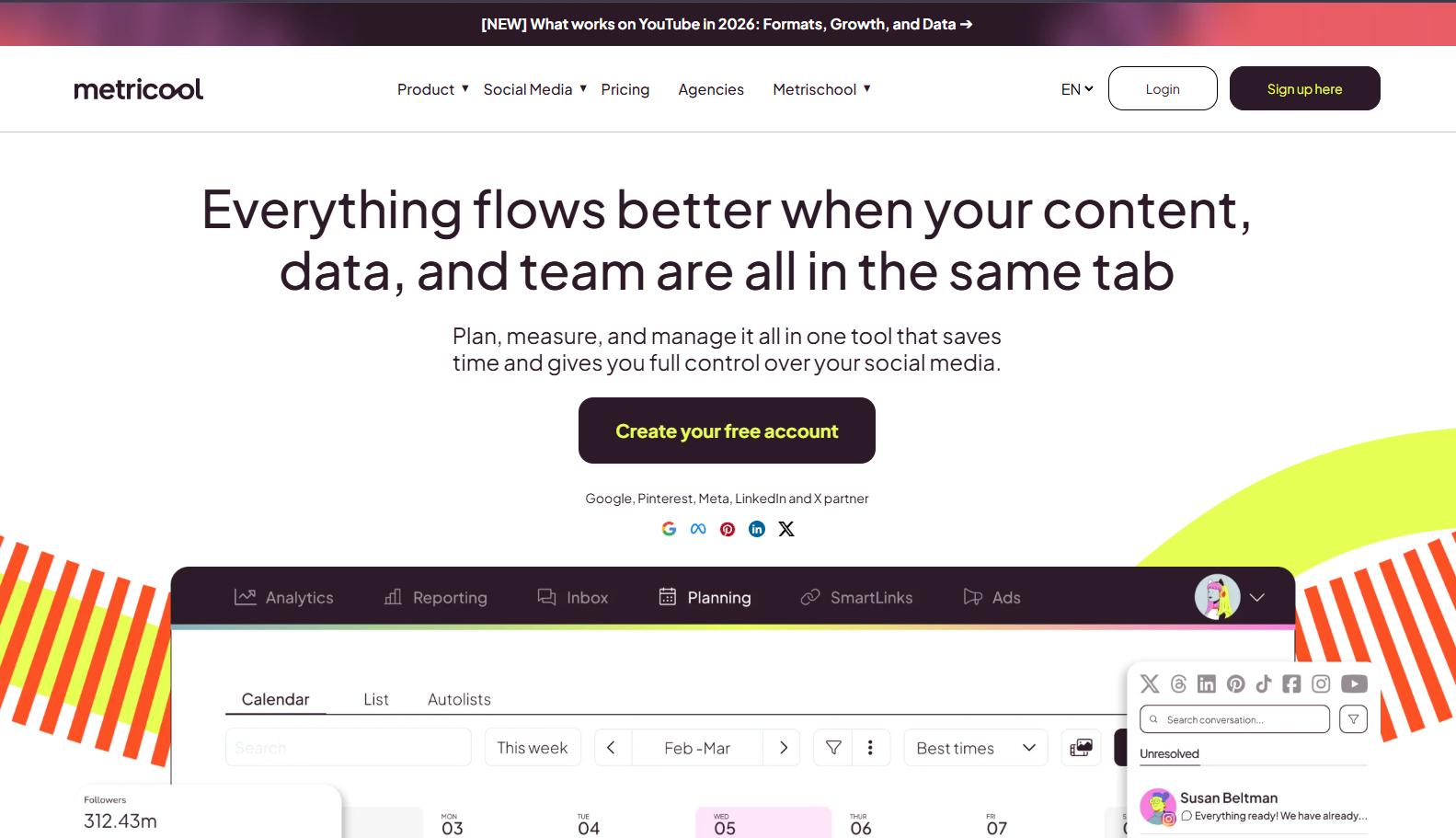
Metricool scores 3.5/5 overall and 5.0/5 on analytics, the highest analytics score in our reviewed pool. Its paid plans include unified social, web, and paid ad data, cross-account reporting, competitor benchmarking, and one-click branded PDF export. The Looker Studio connector sits on Advanced, and cross-account reporting is never a separate purchase the way it is on Agorapulse.
For anyone who hit Agorapulse’s analytics wall, this is the most direct structural answer available. The cost is support quality, which we score 2.0/5 against Agorapulse’s 4.0/5.
Best for: Teams leaving Agorapulse because cross-profile reporting is gated, and who do not need ad comment moderation or GA revenue attribution.
Key Features
Metricool’s differentiation is concentrated in reporting and its pricing axis.
-
Cross-account analytics in every paid plan. Social, web, and paid ad data land in one dashboard with no separate module.
-
One-click branded PDF reports on every paid plan. The Looker Studio connector arrives on Advanced, which is the tier most multi-client agencies buy anyway.
-
Per-brand billing. Metricool charges per brand rather than per user, so adding teammates adds no cost.
-
11 supported platforms, including Twitch and Google Business Profile.
Pros
The advantages over Agorapulse are narrow but decisive where they apply.
-
Analytics depth at 5.0/5 against Agorapulse’s 3.5/5, with no gating and no unlisted add-on price.
-
The free plan covers 1 brand, 20 posts per month, and 30 days of analytics storage, which is enough to evaluate the reporting properly.
-
Competitor tracking covers up to 100 profiles on paid plans, against 5 on free.
-
Approval workflows and role management arrive on the Advanced plan rather than an enterprise contract.
Cons
Four problems are serious enough to disqualify Metricool for some teams.
-
Support scores 2.0/5. Capterra and G2 document slow and unhelpful responses, and Trustpilot rates Metricool 3.9/5 across 622 reviews. Billing and auto-renewal complaints recur.
-
Content creation scores 2.5/5. There is no built-in media library, and the AI assistant is capped at 5 credits per month on free with no bring-your-own-key option.
-
Add-ons stack on the Starter plan. X/Twitter needs a paid add-on on Starter and is included on Advanced. An Advanced Analytics add-on for Metricool Studio and extended history costs extra on top.
-
The inbox is shallower, and there is no GA revenue attribution. Metricool centralizes DMs, comments, and mentions, but adds no routing rules, no ad comment moderation, and no contact history.
Pricing
Metricool prices per brand, and the entry tier is the cheapest paid plan on this page.
| Plan | Monthly (approx. USD) | Brands | X/Twitter |
|---|---|---|---|
| Metricool Free | $0 | 1 (20 posts/mo) | Not included |
| Metricool Starter | ~$20 | 1 (scales by brand count) | Add-on required |
| Metricool Advanced | ~$45 to $53 | Multiple (scales) | Included |
| Agorapulse Standard | $79/user | 1 user, 10 profiles | Included |
| Agorapulse Advanced | $149/user | 1 user, 10 profiles | Included, full analytics |
Metricool lists prices in euros, so dollar figures move with the exchange rate. Check current rates on Metricool’s pricing page.
What Users Say
Reviews split sharply between the reporting workflow and everything after the sale.
-
“It simplified client reporting with clear, insightful data and one-click PDF downloads, saving us hours.” (
-
“The responses were slow, unhelpful, and didn’t address my concern.” (Capterra, verified)
Migrating from Agorapulse to Metricool
The migration is manual and starts your analytics baseline from zero.
-
Export the content calendar and all analytics from Agorapulse’s Reports section before you cancel.
-
Export saved drafts from the Agorapulse content library separately.
-
Create one Metricool brand per client or social set, then connect each account by OAuth.
-
Re-queue every scheduled post. Metricool does not import scheduled content from Agorapulse.
-
Accept that historical analytics do not transfer; your Metricool baseline begins at connection date.
-
Rebuild approvals in Metricool’s post approval settings. Approvals are internal only, with no client-facing portal.
-
Add the X/Twitter add-on on Starter, or move to Advanced, if you manage X accounts.
Read the Metricool review for the full breakdown, or see Metricool alternatives if neither tool fits.
3. Sendible: Best Agency Entry Price (3.3/5)
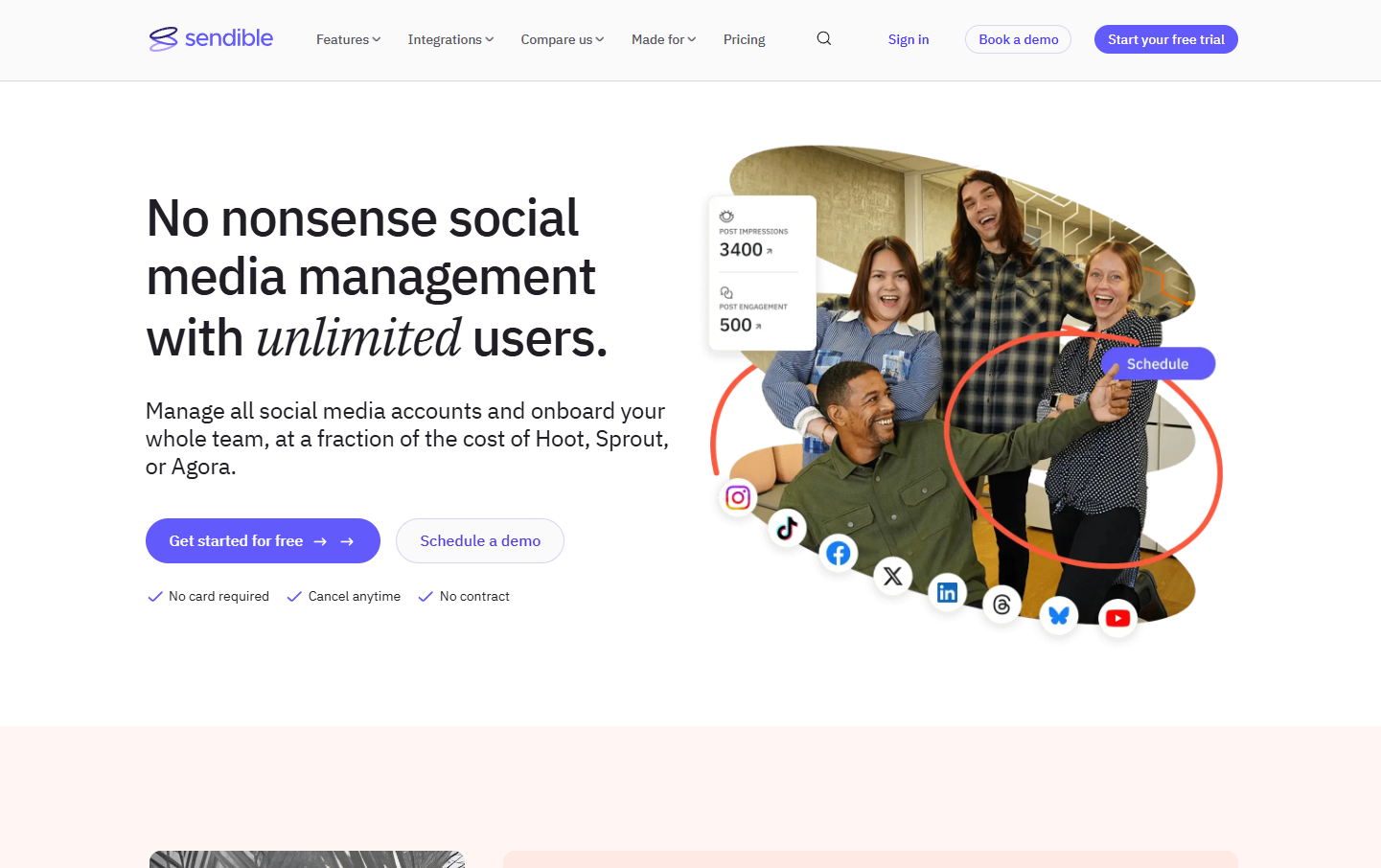
Sendible scores 3.3/5 overall and is built for the same agency buyer Agorapulse targets, at roughly a third of the entry cost. Core starts at about $29 per month on annual billing ($35 monthly) for one workspace, six profiles, and unlimited users. No Sendible tier charges per seat.
Where Agorapulse would bill a three-person agency $237 per month, Sendible Plus covers three client workspaces and 18 profiles for about $84. The trade shows up in channel coverage and connection reliability.
Best for: Small agencies priced out of Agorapulse’s per-seat model who still need client workspaces, approvals, and branded reporting.
Key Features
Sendible’s agency tooling is the reason it belongs on this list.
-
Client Connect. Clients grant access without handing over social account passwords, which removes the credential-sharing step Agorapulse agencies handle manually.
-
Report Hub. Over 200 report modules feed automated, branded client decks. White-label branding starts at Premium.
-
Unlimited users on every plan. Headcount never changes the invoice.
-
Workspace-based structure. Core, Plus, Premium, and Elite scale by workspace and profile count rather than by seat.
Pros
These advantages are specific to teams arriving from Agorapulse’s pricing model.
-
Entry pricing of about $29 per month against $79 per user per month, a material difference for agencies under ten clients.
-
Approval workflows are consistently the most praised part of the product across
-
Ease of use scores 4.0/5, close to Agorapulse’s 4.0/5, so the workflow change is small.
-
WordPress and Medium publishing are native, which Agorapulse does not offer.
Cons
Sendible’s gaps are concentrated in channels and connection stability.
-
Channels score 3.0/5 against Agorapulse’s 4.0/5. There is no Pinterest support, and X/Twitter analytics and inbox were removed after API cost changes, leaving publishing only.
-
LinkedIn reauthorization failures are the most cited complaint across G2 and Capterra. Posts fail silently when a connection drops, which is the same failure class you are leaving.
-
No social listening. The feature was removed and its page now redirects.
-
No REST API or webhooks, so automation runs through Zapier. AI Assist is managed-key only, with no BYOK.
-
No SOC 2 Type II or ISO 27001.
Pricing
Sendible prices by workspace, with unlimited users at every tier.
| Plan | Monthly (annual billing) | Workspaces | Profiles | Users |
|---|---|---|---|---|
| Sendible Core | ~$29 | 1 | 6 | Unlimited |
| Sendible Plus | ~$84 | 3 | 18 | Unlimited |
| Sendible Premium | ~$169 | 7 | 42 | Unlimited |
| Agorapulse Standard | $79/user | N/A | 10 | 1 |
| Agorapulse Professional | $119/user | N/A | 10 | 1 |
Sendible renamed its plans recently, and monthly rates run higher than the annual figures above. Confirm the current structure on Sendible’s pricing page.
What Users Say
The reviews consistently praise approvals and consistently flag connection stability.
-
“I love that the approval process is so easy!” (Emma L., G2)
-
“Posts don’t always publish as scheduled… reauthorized unexpectedly.” (Ashley H., G2)
Migrating from Agorapulse to Sendible
Sendible ships no Agorapulse importer, so the move is a rebuild.
-
Export the Agorapulse content calendar, analytics, and client reports before cancelling.
-
Create one Sendible workspace per client, mirroring your Agorapulse profile groups.
-
Onboard each client through Client Connect rather than collecting passwords.
-
Reconnect every social profile by OAuth, and re-authorize LinkedIn deliberately, since that connection is the documented weak point.
-
Rebuild approval workflows and Report Hub templates. Agorapulse report layouts do not import.
-
Move Pinterest and X/Twitter reporting to another tool, because Sendible does not cover either.
Read the Sendible review for the full scorecard, or see Sendible alternatives for the wider field.
4. SocialBee: Best for Evergreen Content Recycling (3.3/5)
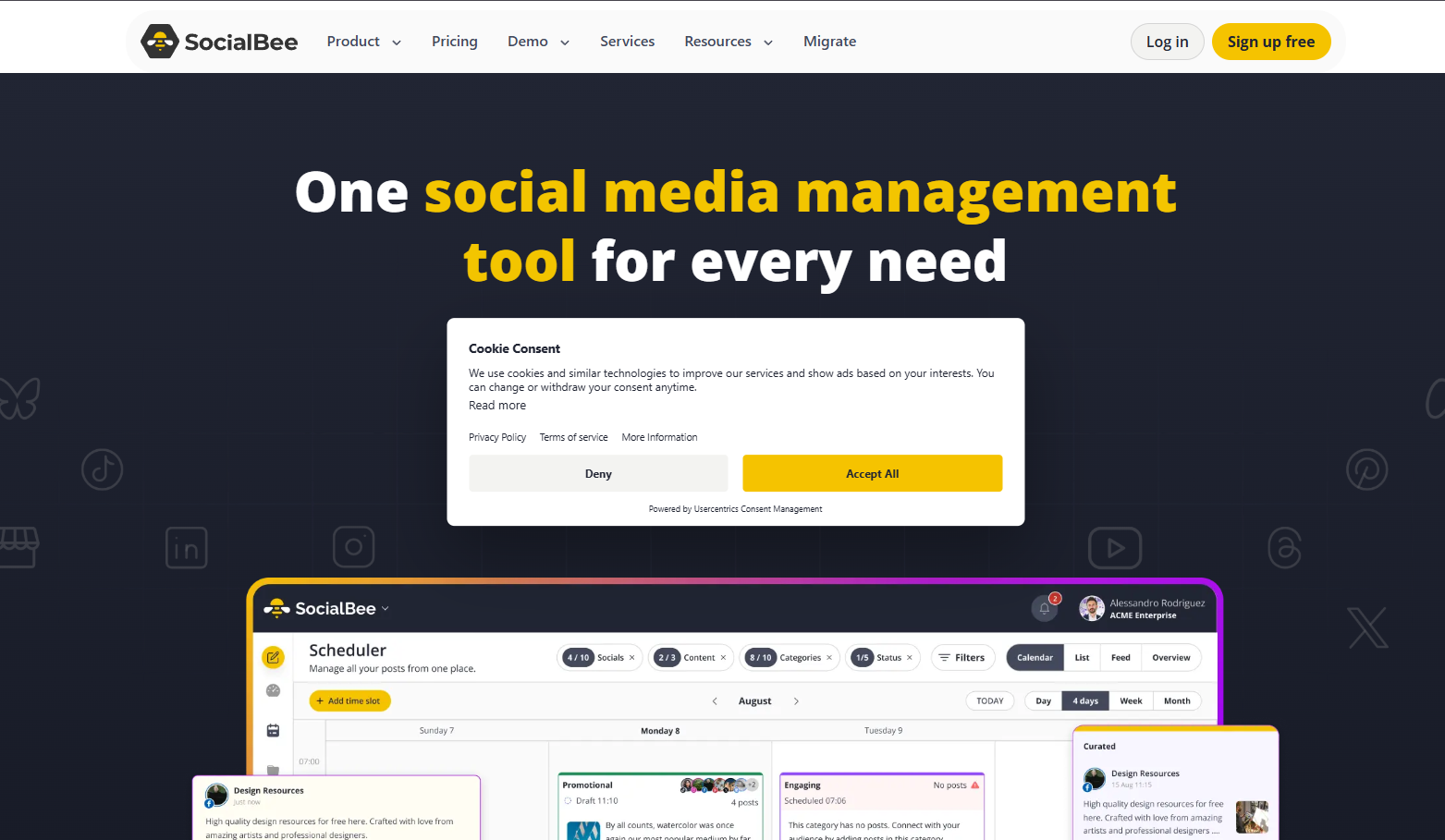
SocialBee scores 3.3/5 overall, and it is on this list for a workflow reason rather than a pricing one. Its category-based queue recycles evergreen content automatically, which is the one capability Agorapulse does not have at any tier.
Treat this as a change of publishing model, not a cost swap. Bootstrap starts at $24.20 per month on annual billing, but users, workspaces, and profile packs are all add-ons that stack.
Best for: Content-first publishers who batch evergreen material once and want the queue to keep republishing it without daily scheduling work.
Key Features
SocialBee’s structure differs from Agorapulse in three concrete ways.
-
Category-based evergreen recycling. Content is grouped into topic categories with repeating time slots, and the queue recycles when a category empties.
-
Unlimited AI generation on every plan, including captions and images, with no per-credit metering.
-
ConciergeBee. A marketplace of over 100 certified social media managers for done-for-you content, which has no Agorapulse equivalent.
-
Bulk editing and CSV import from the Accelerate plan upward.
Pros
SocialBee earns its place for a narrow but genuine set of reasons.
-
Content creation scores 3.5/5 against Agorapulse’s 3.0/5, driven by unlimited AI and the content library.
-
Support scores 4.0/5, matching Agorapulse, which is rare among cheaper tools.
-
Category recycling removes the daily calendar refill that Agorapulse users do manually.
-
Entry pricing of $24.20 per month annual is the lowest recurring price on this page.
Cons
The interface and the add-on stack are the real costs.
-
Ease of use scores 3.0/5 against Agorapulse’s 4.0/5. There is no drag-and-drop calendar and no unified cross-account calendar view.
-
The social inbox covers 6 of 10 supported networks. TikTok, Pinterest, Google Business Profile, and Bluesky have no inbox support at all.
-
Analytics score 3.0/5. There is no social listening and no competitor benchmarking beyond Facebook, and history caps at 3 months on Bootstrap.
-
Add-ons stack fast. Extra users cost $10 per month, extra workspaces $10 per month, and profile packs $15 per 5 profiles. Even the top Pro150 plan, $374.20 per month on annual billing, caps at 5 users.
-
No MCP server, no BYOK, no public API, and no SOC 2 or ISO 27001.
Pricing
SocialBee’s plan prices are low, but the user cap is the constraint that matters for teams.
| Plan | Monthly (annual billing) | Profiles | Users |
|---|---|---|---|
| SocialBee Bootstrap | $24.20 | 5 | 1 per workspace |
| SocialBee Accelerate | $40.83 | 10 | 1 per workspace |
| SocialBee Pro | $82.50 | 25 | 3 per workspace |
| SocialBee Pro150 | $374.20 | 150 | 5 total |
| Agorapulse Standard | $79/user | 10 | 1 |
Bootstrap costs $29 per month without annual billing. Add-on rates are published on SocialBee’s pricing page.
What Users Say
Reviews are enthusiastic about the time saved and specific about the failure mode.
-
“Set up a year’s posts in one day.” (Deborah Parsley, SocialBee testimonials)
-
“If there is one misconfigured post in a category then the category stops posting.” (
Migrating from Agorapulse to SocialBee
The rebuild here is larger than a straight import, because the scheduling model differs.
-
Export the Agorapulse calendar and analytics before cancelling.
-
Group your existing content into SocialBee categories, which is the step with no Agorapulse equivalent.
-
Connect each profile by OAuth, and confirm which of your networks have inbox coverage.
-
Upload evergreen content in bulk by CSV on Accelerate or above, then assign categories and time slots.
-
Test one category end to end before enabling the rest, because a single malformed post halts its whole category.
-
Add user, workspace, or profile-pack add-ons only after the base plan is running, so the real monthly cost is visible.
Read the SocialBee review for the full analysis, or see SocialBee alternatives for adjacent options.
5. Hootsuite: Best for Enterprise Feature Depth (3.6/5)
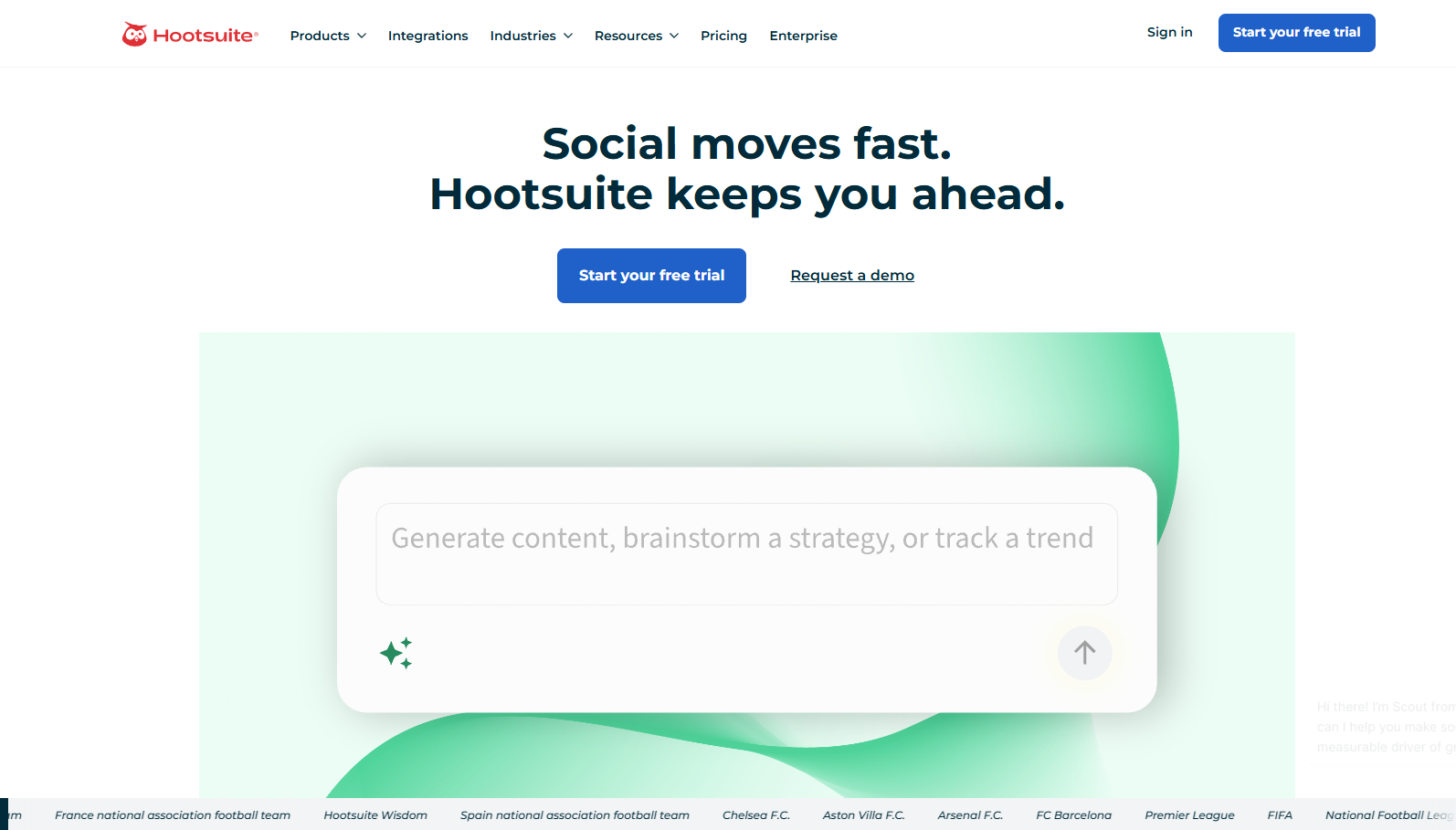
Hootsuite scores 3.6/5, the highest Layer-1 score on this page, and it is not a cost reduction. Standard starts at $99 per month against Agorapulse Standard’s $79 per user per month. Hootsuite’s published page does not state a per-seat rate for additional users.
That makes Hootsuite a feature-depth move rather than a pricing move. It brings broader channel coverage, deeper analytics, and stronger content tooling. It scores worse than Agorapulse on pricing, ease of use, and support.
Best for: Teams that want more platform coverage, more integrations, and native listening, and for whom cost is not the reason for leaving.
Key Features
Hootsuite’s advantage is breadth, and it is measurable.
-
10 native networks plus over 100 app integrations in the Hootsuite App Directory, the broadest set on this page. See the
-
Talkwalker listening. Hootsuite acquired Talkwalker in April 2024. Brand monitoring ships from the $99 Standard plan, and the full Talkwalker suite is Enterprise only.
-
OwlyWriter AI for caption and image generation, scoring 4.0/5 on content creation against Agorapulse’s 3.0/5.
-
Bulk scheduling up to 350 posts per upload for high-volume publishing.
Pros
Three advantages hold up against Agorapulse directly.
-
Channels score 4.5/5 against Agorapulse’s 4.0/5, and analytics score 4.0/5 against 3.5/5, with no unlisted reporting add-on.
-
Brand monitoring is included from the $99 Standard plan, while Agorapulse sells Advanced Listening as an add-on with no published price.
-
Hootsuite Academy has certified over 30,000 users, which shortens onboarding for large teams.
-
Capterra rates Hootsuite 4.4/5 across 3,799 reviews from active users.
Cons
The reputational and cost picture is the reason Hootsuite sits in Tier 2.
-
Pricing scores 2.0/5 against Agorapulse’s 2.5/5. It costs more, which is decisive for cost-motivated switchers.
-
Support scores 2.5/5 against Agorapulse’s 4.0/5.
-
Ease of use scores 3.0/5. Interface complexity is the most consistent theme in negative reviews.
-
Posts can fail silently here too. This is the most common functional complaint on Capterra, so it is not a fix for Agorapulse’s reliability trigger.
-
Approval workflows require the Advanced plan, and white-label reports and client portals are Enterprise-only.
-
No native MCP server and no BYOK AI.
Pricing
Hootsuite publishes base plan prices, and its seat structure is the ambiguity to resolve before buying.
| Plan | Monthly (annual billing) | Social accounts |
|---|---|---|
| Hootsuite Standard | $99 | 10 |
| Hootsuite Professional | $199 | Unlimited |
| Hootsuite Advanced | $399 | Unlimited |
| Agorapulse Standard | $79/user | 10 profiles |
| Agorapulse Professional | $119/user | 10 profiles |
Hootsuite’s page describes Standard as covering “1+ user seats” without publishing the per-seat rate. Confirm the total cost for your team size on Hootsuite’s plans page before committing.
What Users Say
The gap between active users and former customers is the widest of any tool here.
-
“It saves us many hours of work and does a fantastic job at everything we want.” (Inaki H.,
-
“Overpriced for the value and experience it offers. Not always reliable.” (Zaid E., Capterra)
Migrating from Agorapulse to Hootsuite
Hootsuite has no Agorapulse importer, and the setup effort is the largest on this page.
-
Export the Agorapulse calendar, analytics, and reports before cancelling.
-
Start the 14-day Hootsuite trial and connect accounts before the Agorapulse subscription lapses, so you can run both briefly.
-
Rebuild your streams and dashboard layout, which is where most of the onboarding time goes.
-
Re-create scheduled posts through the bulk composer, using your Agorapulse CSV export as the source.
-
Confirm which tier your approval workflow needs, since approvals begin at Advanced.
-
Read the contract terms before signing, because Enterprise agreements auto-renew with a 60-day cancellation notice.
Read the Hootsuite review for the full scorecard, or see Hootsuite alternatives if the pricing does not work.
6. Planable: Best for Approval Workflows (3.6/5)
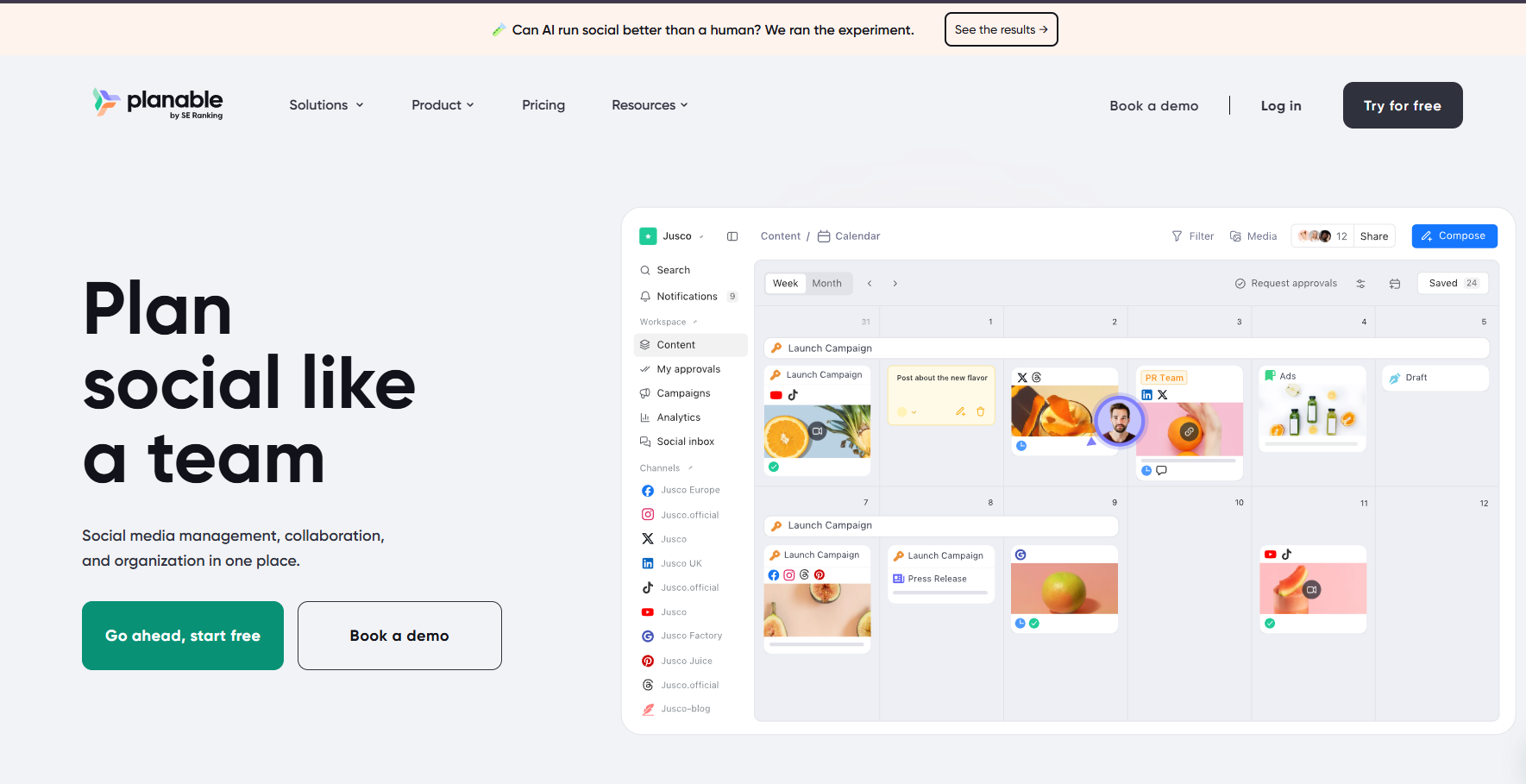
Planable scores 3.6/5 and beats Agorapulse on the one workflow agencies complain about most. Its entire product is built around client approval: guest reviewers need no account, approvals can be multi-level, and every comment threads on the post itself.
Planable also removes per-seat billing, charging per workspace with unlimited users on every plan. What it does not do is analytics. Reporting is a $12 per workspace per month add-on, so anyone leaving Agorapulse over analytics gating lands in a worse position.
Best for: Agencies whose main frustration with Agorapulse is the approval cycle rather than reporting depth or inbox coverage.
Key Features
Planable’s differentiation is collaboration, and it is unusually deep.
-
Client-facing approval without accounts. External reviewers approve or comment through a shared link, with no paid seat required.
-
Three approval types on Pro, plus multi-level approval on Enterprise.
-
Native-style previews. Posts render as they will appear on each network, with feed, calendar, and grid views.
-
Per-workspace billing with unlimited users, so team growth costs nothing.
Pros
The advantages over Agorapulse are concentrated and real.
-
Content creation scores 4.0/5 against Agorapulse’s 3.0/5, and ease of use scores 4.5/5 against 4.0/5.
-
G2 rates Planable 4.6/5
-
Version history and threaded post comments remove the email and screenshot loop entirely.
-
Unlimited users on every plan removes the per-seat escalation you are leaving.
Cons
Planable’s gaps are severe if your switching trigger is anything other than approvals.
-
Analytics score 2.5/5 and cost extra. The add-on runs $12 per workspace per month and excludes X/Twitter, Pinterest, and Threads.
-
No social inbox. DMs, ad comments, and mentions are not covered; a Social Inbox add-on costs a further $7.50 per workspace per month.
-
Monthly post caps. Basic allows 60 posts per workspace and Pro allows 150, which is unusual in this category.
-
9 supported platforms against Agorapulse’s 11, and no social listening or GA ROI attribution.
-
Per-workspace cost stacks. Ten client workspaces on Pro reach $490 per month before add-ons.
-
No SOC 2 Type II or ISO 27001.
Pricing
Planable’s cost depends entirely on client count rather than team size.
| Plan | Monthly | Posts per workspace | Social pages | Analytics |
|---|---|---|---|---|
| Planable Basic | $33/workspace | 60 | 4 | Add-on (+$12) |
| Planable Pro | $49/workspace | 150 | 10 | Add-on (+$12) |
| Planable Enterprise | Custom | Unlimited | Custom | Custom |
| Agorapulse Standard | $79/user | Unlimited | 10 profiles | Basic |
| Agorapulse Advanced | $149/user | Unlimited | 10 profiles | Full |
Three client workspaces on Pro cost $147 per month against $237 for a three-person Agorapulse Standard team. Ten workspaces reach $490 against $790 for ten Agorapulse seats. Current rates are on Planable’s pricing page.
What Users Say
Reviewers are consistent about what Planable fixes and what it charges extra for.
-
“Being able to easily share content previews for approval are exactly what I’ve been looking for.” (Capterra)
-
“Analytics aren’t included in the base plans, tucking that behind an extra paywall.” (Capterra)
Migrating from Agorapulse to Planable
The rebuild is straightforward, because Planable’s scope is narrower than Agorapulse’s.
-
Export the Agorapulse calendar and reports before cancelling.
-
Create one Planable workspace per client, matching your Agorapulse profile groups.
-
Invite clients as guest reviewers rather than paid users, which is the cost saving that matters.
-
Reconnect social pages by OAuth, keeping the 4-page (Basic) or 10-page (Pro) limit per workspace in mind.
-
Add the Analytics module per workspace if you report to clients, and budget $12 per workspace per month.
-
Keep a separate tool for DMs and ad comments, or add the Social Inbox module, because Agorapulse’s inbox has no equivalent here.
Read the Planable review for the full breakdown, or see Planable alternatives for other approval-first tools.
7. PostMonk: Best for Lifetime Pricing and Agentic AI (3.1/5)
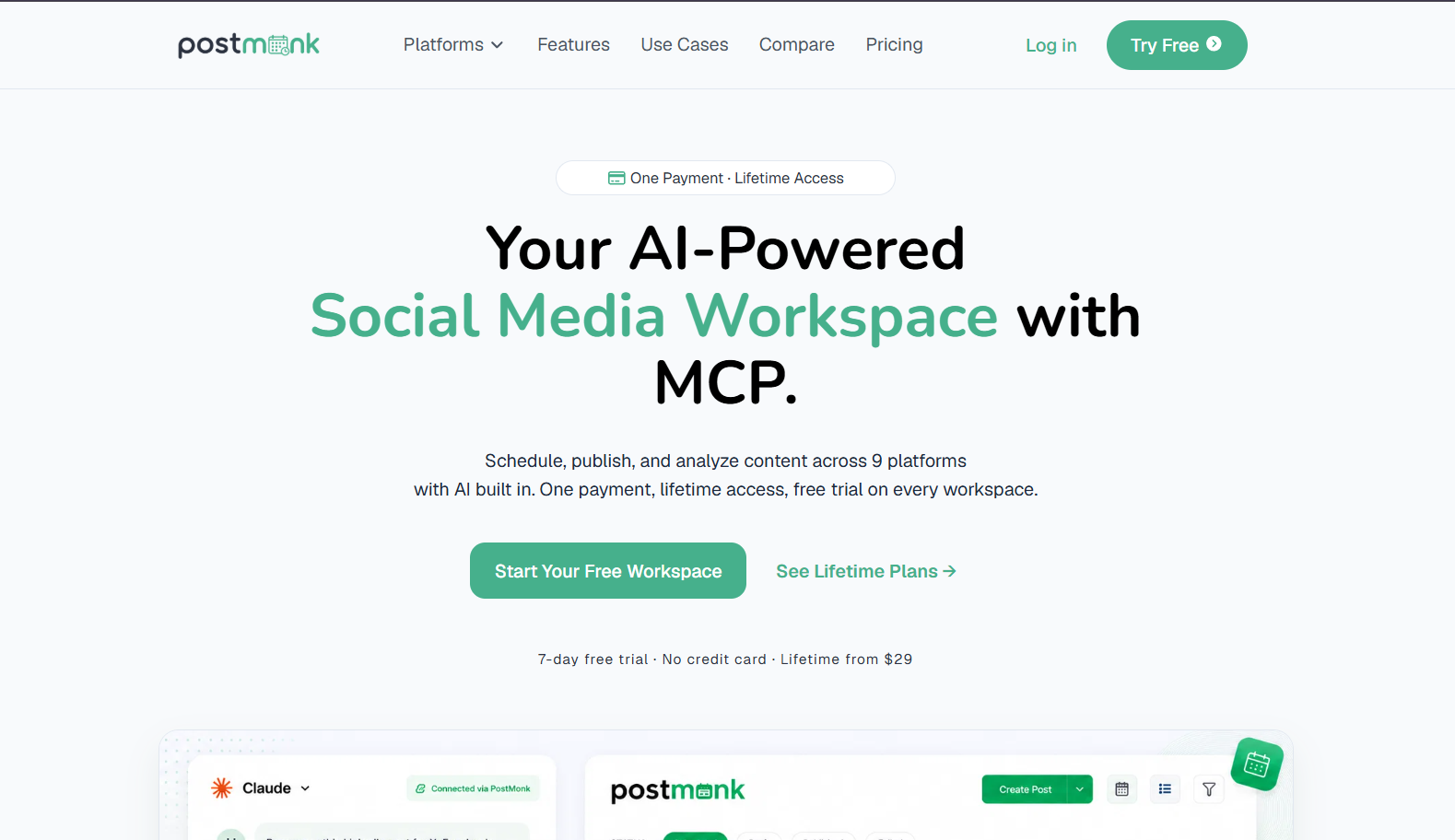
PostMonk scores 3.1/5, the lowest score on this page and below Agorapulse’s 3.5/5. It loses on analytics (2.5 against 3.5), channels (3.0 against 4.0), ease of use (3.0 against 4.0), and support (1.5 against 4.0). It wins on exactly two things, and they are structural rather than incremental.
The first is pricing: $29, $59, or $99 once, with no recurring bill and no per-seat escalation. The second is agent control. PostMonk ships a full read-write MCP server on Pro and Agency. Agorapulse’s own MCP is documented as “assistants, not agents, never acts alone” (Agorapulse MCP documentation).
Best for: Solo operators and AI-forward teams whose workflow is scheduling and content creation, with no need for an inbox or GA attribution.
Key Features
Four capabilities define the narrow case where PostMonk beats Agorapulse.
-
One-time lifetime pricing per workspace. Starter $29, Pro $59, Agency $99, with 1, 3, and 10 seats respectively.
-
BYOK AI on every plan. Connect your own OpenAI, Anthropic, Gemini, OpenRouter, or DeepSeek key instead of buying metered credits.
-
Agentic MCP server on Pro and Agency. Claude, ChatGPT, or a custom agent can schedule posts, approve drafts, manage media, and query analytics directly.
-
White-label client portal and branded PDF reports on the Agency plan at $99 once, against Agorapulse’s unlisted Custom-tier pricing.
Pros
These are the advantages that survive an honest comparison.
-
Pricing scores 4.5/5 against Agorapulse’s 2.5/5, the largest single category gap between the two tools.
-
A 10-seat team pays $99 once on Agency against $9,480 a year for 10 Agorapulse Standard seats.
-
BYOK AI removes the double charge teams pay when they already hold an OpenAI or Anthropic subscription.
-
Client approval portals, scoped client invites, and workspace isolation are included at $99 rather than gated to an enterprise contract.
Cons
The gaps are wide, and several of them are disqualifying.
-
No unified social inbox. No DM management, no ad comment moderation, no Inbox Assistant, and no contact history. If your day runs through Agorapulse’s inbox, PostMonk is the wrong choice.
-
No social listening and no Google Analytics ROI attribution. PostMonk applies UTM parameters per Brand Asset, but the attribution reporting happens in your own analytics tool.
-
Support scores 1.5/5. There is no live support on lower tiers and no published response-time SLA, against Agorapulse’s claimed 30-minute average.
-
No independent review record. PostMonk has no entries on G2, Capterra, or TrustRadius, so there is no peer-verification layer behind these claims.
-
9 networks against Agorapulse’s 11, and no confirmed mobile app.
-
No SOC 2 Type II or ISO 27001, and no public reliability track record, because the product is pre-traction.
Pricing
PostMonk charges once per workspace, which is the whole argument for it.
| Plan | Price | Type | Seats | Accounts | MCP | BYOK AI |
|---|---|---|---|---|---|---|
| PostMonk Starter | $29 | One-time | 1 | 5 | No | Yes |
| PostMonk Pro | $59 | One-time | 3 | 25 | Yes | Yes |
| PostMonk Agency | $99 | One-time | 10 | 100 | Yes | Yes |
| Agorapulse Standard | $79/user/month | Recurring | 1 | 10 profiles | Assistant only | No |
| Agorapulse Professional | $119/user/month | Recurring | 1 | 10 profiles | Assistant only | No |
| Agorapulse Advanced | $149/user/month | Recurring | 1 | 10 profiles | Assistant only | No |
Every plan includes a 7-day trial and a 30-day money-back guarantee after activation. Current tiers and limits are on the PostMonk pricing page.
What Users Say
PostMonk has no third-party review record yet, which is a fair reason for caution.
There are no G2, Capterra, or TrustRadius entries for PostMonk as of July 2026. Agorapulse, by contrast, carries 973 G2 reviews at 4.5/5. Treat the absence of public reviews as an unresolved risk, not a neutral fact. Use the 7-day trial to verify the workflow before you buy.
Migrating from Agorapulse to PostMonk
Migration is manual, and several Agorapulse workflows have no destination.
-
Export the Agorapulse content calendar and scheduled posts from the Reports and Export section.
-
Download analytics PDFs and CSVs before cancelling, since historical data does not transfer.
-
Create the PostMonk workspace and set up one Brand Asset per brand or client.
-
Connect social profiles by OAuth. Each network needs fresh authorization.
-
Add your AI provider key in PostMonk’s AI settings, which is required for the AI features.
-
Re-queue scheduled content by hand or through bulk CSV import on Pro and Agency.
-
Connect the MCP server to your agent on Pro or Agency if you want autonomous scheduling.
-
Accept the permanent gaps: inbox, listening, and GA attribution have no PostMonk equivalent.
For the direct head-to-head on pricing, features, and segment verdicts, read PostMonk vs Agorapulse.
Best Agorapulse Alternative for Agencies
Agency buyers weight these categories differently from general buyers, so the general ranking does not answer their question. The agency composite re-weights the same category scores toward analytics (16%), scheduling (12%), and ease of use (12%). It then adds two decisive sub-factors: client workspaces plus multi-brand roles (16%), and approval workflows plus white-label reports (14%).
Scored that way, only one tool on this page beats Agorapulse for agencies.
| Tool | Agency composite | Client workspace score | Approval and white-label score | Agency rank |
|---|---|---|---|---|
| Planable | 3.86/5 | 4.5/5 | 5.0/5 | 1 (above Agorapulse) |
| Agorapulse | 3.83/5 | 4.5/5 | 4.5/5 | 2 |
| Sendible | 3.59/5 | 4.0/5 | 4.0/5 | 3 |
| Metricool | 3.53/5 | 3.5/5 | 3.0/5 | 4 |
| Hootsuite | 3.40/5 | 3.5/5 | 3.0/5 | 5 |
| PostMonk | 3.28/5 | 4.0/5 | 4.0/5 | 6 |
| Buffer | 3.10/5 | 2.5/5 | 2.0/5 | 7 |
| SocialBee | 3.01/5 | 2.5/5 | 2.5/5 | 8 |
Planable edges Agorapulse by 0.03 on a 5-point scale, entirely on approval workflows and white-label reporting. Its per-workspace billing also removes seat cost as agencies add staff. For agencies whose friction is the approval cycle, Planable is the strongest replacement.
Sendible and Metricool follow. Sendible wins on transparent entry pricing and credential-free client onboarding, and Metricool wins on reporting depth included in the base plan. Buffer and SocialBee are not agency tools: Buffer lacks multi-level approvals and white-label reporting, and SocialBee caps at 5 users on every plan.
One gap none of them closes: Agorapulse holds SOC 2 Type II and ISO 27001:2022, and no alternative in this pool holds both. For agencies serving enterprise or regulated clients, that alone can end the evaluation.
For the wider agency shortlist beyond this competitor set, see best social media tools for agencies.
Verdict: Which Agorapulse Alternative Should You Pick?
The right alternative depends entirely on which trigger sent you looking, so pick from the condition that matches yours.
-
If your Agorapulse bill grows with every seat and you do not use the inbox: Buffer. Team costs $10 per channel per month with unlimited users, so a 3-person team on 10 channels pays $100 instead of $237.
-
If cross-profile analytics are gated and reporting is your main output: Metricool. It scores 5.0/5 on analytics, with cross-account reporting and branded PDF export on every paid plan and Looker Studio on Advanced.
-
If you run a small agency and $79 per seat is the problem: Sendible. Core starts near $29 per month with unlimited users, Client Connect onboarding, and over 200 Report Hub modules.
-
If you publish high-volume evergreen content and refill the calendar by hand: SocialBee. Category-based recycling republishes a batch built once, which Agorapulse cannot do at any tier.
-
If you want more capability rather than a lower bill: Hootsuite. It scores 3.6/5 with the broadest channel set, over 100 integrations, and analytics at 4.0/5 against Agorapulse’s 3.5/5.
-
If the client approval cycle is your real friction: Planable. It wins the agency composite at 3.86/5 on the strength of no-account client approvals and multi-level workflows.
-
If you want no recurring bill and an AI agent that acts on its own: PostMonk. Plans are $29, $59, or $99 once, with BYOK AI on all tiers and a read-write MCP server on Pro and Agency.
-
If your team lives in the social inbox every day: Stay on Agorapulse. Nothing here replicates the unified inbox, Inbox Assistant, ad comment moderation, or contact history.
-
If you report social ROI through Google Analytics: Stay on Agorapulse. No alternative on this page attributes revenue and leads from organic posts through GA4.
-
If procurement requires SOC 2 Type II and ISO 27001: Stay on Agorapulse. No alternative in this pool holds both certifications.
Agorapulse remains a genuinely strong product for the buyer it was built for. The tools above beat it on cost structure, analytics access, approval UX, or publishing model, and on nothing else. If two or more of those matter more to you than the inbox, switching is worth the rebuild.
PostMonk’s Starter workspace is $29 once, with a 7-day trial before you pay: start a PostMonk workspace.
For the wider category view, read the social media management platform overview. For every tool we score, see the best social media management tools roundup.
FAQs
What are the best Agorapulse alternatives?
The strongest Agorapulse alternatives are Buffer, Metricool, Sendible, SocialBee, Hootsuite, Planable, and PostMonk, depending on which Agorapulse limitation you are escaping. Buffer and PostMonk answer per-user pricing, Metricool answers gated analytics, Planable answers approval workflows, and Hootsuite answers feature breadth. None of them matches Agorapulse’s inbox depth.
Does Agorapulse have a free version?
Yes. Agorapulse’s free plan covers one user, three social profiles, and ten scheduled posts. It is an evaluation tier rather than a working plan, and paid tiers start at $79 per user per month on annual billing. Buffer and Metricool both offer more capable free plans if a permanent free tier is what you need.
What is the best free alternative to Agorapulse?
Buffer and Metricool have the two strongest free plans. Buffer’s covers 3 channels, 10 queued posts per channel, and 100 stored ideas with no time limit. Metricool’s covers 1 brand, 20 posts per month, and 30 days of analytics history. Metricool is better for reporting; Buffer is cleaner for pure scheduling.
How much does Agorapulse cost?
Agorapulse costs $79 per user per month on annual billing for Standard, $119 for Professional, and $149 for Advanced. Monthly billing runs $99, $149, and $199. Each base plan includes one user and 10 social profiles, so a 3-person Standard team pays $237 per month, or $2,844 a year, before add-ons.
Is Agorapulse better than Hootsuite?
Neither wins outright. Hootsuite scores 3.6/5 against Agorapulse’s 3.5/5, with broader channel coverage, more integrations, and deeper analytics. Agorapulse scores higher on support (4.0 against 2.5) and ease of use (4.0 against 3.0). Hootsuite’s Trustpilot rating of 1.3/5 across 554 reviews is a real risk signal for billing disputes.
Is Buffer a good alternative to Agorapulse?
Buffer is a good alternative if per-user pricing is your problem and the social inbox is not part of your workflow. Buffer Team removes seat cost entirely at $10 per channel per month with unlimited users. It scores 2.5/5 on analytics against Agorapulse’s 3.5/5, has no unified inbox, and shows the same documented silent post failure pattern.
What is the cheapest Agorapulse alternative for agencies?
PostMonk Agency is the lowest total cost at $99 once, if no inbox, listening, or GA attribution is required. Among recurring subscriptions, SocialBee Bootstrap is cheapest at $24.20 per month annual, then Sendible Core near $29 with unlimited users. Planable Basic at $33 per workspace gives the most transparent per-client pricing.
What is the best Agorapulse alternative for analytics?
Metricool. It scores 5.0/5 on analytics, the highest in our reviewed pool. Every paid plan includes cross-account reporting, competitor benchmarking, and one-click PDF reports, with the Looker Studio connector on Advanced. The trade is support quality, which scores 2.0/5 against Agorapulse’s 4.0/5.
How long does it take to migrate from Agorapulse to another tool?
Plan a half day for a single-brand setup and one to two days per client workspace for an agency. No tool on this page imports Agorapulse data directly. The time goes into fresh OAuth authorization per network, re-queuing scheduled posts from a CSV export, and rebuilding approval workflows and report templates.
Can I import my Agorapulse data into another tool?
No direct importer exists in any of the seven alternatives here. Agorapulse exports scheduled content, analytics, and reports in CSV, PDF, and PowerPoint from its Reports section, and that export is your starting point. Historical analytics, inbox history, saved replies, and listening data do not transfer anywhere. Plan a clean break rather than a migration.